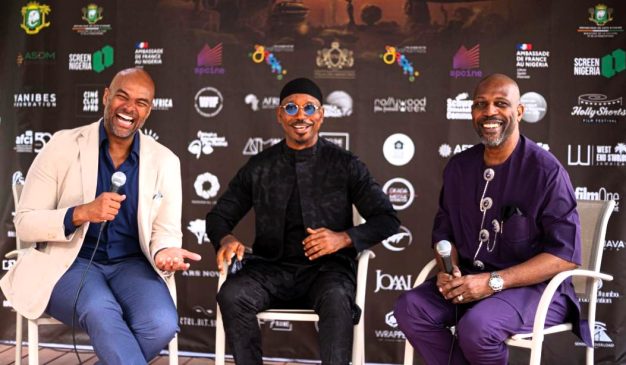
*Left to Right: Adonai Owiiwa, Prince Tonye Princewill, Kene Okwuosa
Nigeria’s growing influence within the global creative ecosystem was once more relieved at the just concluded Cannes Film Festival, in France. From film to music, art paintings, sculpture, fashion, info-technology, the outings of Nigeria in recent times continues to shape the nations global presence. For a nation with undisputedly rich culture, and the dominant powerhouse for storytelling in Africa, Nigeria’s participation at the Cannes film festival, with the preview of the historical film thriller “77: The Conspiracy of FESTAC” made a strong statement. The interplay of Nigeria’s cinema, its cross border influence and international audience acceptance and the renaissance of African cinema was the centerpiece of the special screening of “77: The Conspiracy of FESTAC”; in some way a major reflect on the Second World Black and African Festival of Arts and Culture (FESTAC ’77), remains a pivotal moment in Nigeria’s creative and cinematic history in 1977. Resurrecting FESTAC 77, forty-nine years after, through the film is a thrill and relieves enduring memories of the event that took place almost fifty decades ago.
For decades that the red carpets of the Cannes Film Festival unfurled for cinematic giants, Nigeria, Africa’s most prolific film industry remained conspicuously absent from its hallowed official selections. However, history cracked open its doors as Nigeria stormed the Croisette with landmark of the highly anticipated preview of “77: The FESTAC Conspiracy” – a moment Dr. Ali Nuhu, Nigerian Film Corporation’s (NFC) Managing Director says, does not only present an opportunity for the global film community to appreciate a determined and redefined narrative of Africa’s cinema that is imbued with captivating rich culture and history but “strategic for attracting vital support and resources to our film industry”. In the high-stakes arena where arthouse cinema crowns its royalty, Nigeria’s presence was not merely courtesy appearance; it was a thunderous declaration of her artistic arrival.
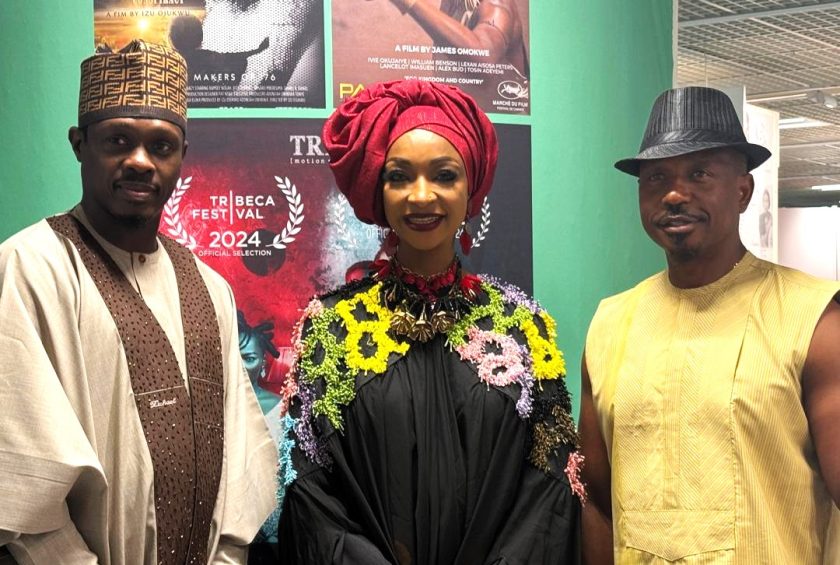
FESTAC ’77 was symbolic. Africa stood united in the true essence of cultural supremacy. Against the backdrop of post-colonial renaissance, Nigeria is reported to have invested some $400 million (equivalent to ~$2 billion today) to host the Second World Black and African Festival of Arts and Culture (FESTAC ’77). For one month, Lagos, Nigeria’s present hub for innovative creative enterprises transformed into the pulsating heart of the African diaspora, welcoming about 17,000 participants from 55 nations. Icons like Fela Kuti, Miriam Makeba, Stevie Wonder, Audre Lorde, and Sun Ra converged on the majestic National Theatre, creating what remains the largest Pan-African gathering in world history. As Dr. Nuhu emphasized at Cannes, this festival embodied Nigeria’s audacious vision as a “continental creative powerhouse” – a vision the NFC is reigniting.
Beyond Nostalgia: “77” is a cinematic time machine. Directed by Izu Ojukwu and produced by Adonis Productions, “77: The FESTAC Conspiracy” is far more than a period piece. A meticulously crafted resurrection of an era that defined modern African cultural identity, is a better description. The film reunites the powerhouse duo of Ramsey Nouah and Rita Dominic, reprising their roles as Captain Joseph Dewa and Suzy from the acclaimed political thriller “76.” This sequel sees them rebuilding lives in Lagos amidst the euphoric chaos of FESTAC, only to be entangled in a geopolitical conspiracy stretching across countries and continents. The production spared no effort in its authenticity. The sourcing of vintage automobiles and other props are attestations. The casting of Seun Kuti as his legendary father Fela Aníkúlápó-Kuti for the role was brilliant. The Cannes preview of the film has continued to elicited international positive reactions, including investment opportunities, thereby not only validating its global appeal but a confirmation of a growing audience appeal and acceptance of Nigeria’s cinema.
Nigeria’s towering creative influence remains impressive, especially at a time when President Ahmed Tinubu’s administration is recalibrating the creative sector through the NIGERIA EVERYWHERE and DESTINATION 2030 policy initiatives, alongside the planned injection of about $300 million into Nigeria’s creative sector, targeting a $100 billion GDP contribution within five years.
Selected for screening by the Nigerian Film Corporation (NFC), the film provided a first view opportunity for international audience to savor the incredible, artistic savvy storytelling as well as content production that showcased not just Nigeria’s creative ingenuity, but emerging expertise. its boundless market penetration. The advancement of Nigeria’s cinema remains paramount, Dr. Ali Nuhu says; aims at supporting efforts in addressing funding for film makers, training, production, distribution bottlenecks, and cinema infrastructure. Nigeria’s outing at the 2025 Cannes film festival was indeed a success.