By Agbo Favour Amarachi
BLOOD Vessel has similar story lines as Gangs of Lagos (2023), Collision Course (2021), Dark October (2023), and The Black Book (2023), although with different tilt and filmmaking touches.
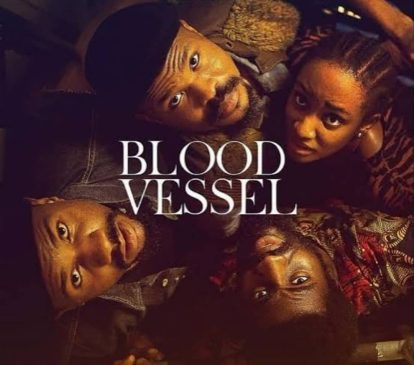
Their collective escape from their community’s upheaval with the military leads them to become inadvertent stowaways on a mysterious vessel. They are subsequently thrust into a perilous journey fraught with unforeseen dangers.
What initially promised a chance at a better life soon transforms into a harrowing struggle for survival, testing the boundaries of friendship, exposing betrayal, and exploring the intricacies of love and vulnerability.
The movie’s dialogue is mainly in Ijaw, Niger Delta pidgin, Russian, Urhobo and Igbo.
The exploration of other languages from Nollywood stands Blood Vessel out and inspires other Nollywood filmmakers to explore beyond the comfort zone of “WaZoBia”, and, knowing there are actors willing to play roles, and learn any language in order to execute said role, should be quite an encouraging thought.
Blood Vessel’s focus on highlighting some of the important issues that oil communities face is what makes it distinct and puts it in contention as a potential classic. The themes highlighted include oil spills that rub communities of livelihood, oil theft actively run by the powerful political class, a caste system that alienates certain groups in the society no matter their talents, and the dangerous Mediterranean passage that continues to claim the lives of young men and women searching for greener pastures through the ocean.
“We Africans must take it upon ourselves to tell our own African stories as we live them – raw and unfiltered, portraying our successes and challenges exactly as we wish to be perceived, seen, received, and understood by the world,” said Charles Okpaleke, executive producer and producer of Blood Vessel.
The movie pays homage to the scourge of illegal migrants who take the most dangerous routes to leave their home countries for greener pastures abroad. As is natural, every illegal migrant has their story, and it is even more so here in Blood Vessel, where each dividend pair of the six travelling characters have different reasons for migrating. Abbey (David Ezekiel) and Oyin (Dibor Adaobi) are eloping from Oyin’s vindictive father, Ebiye (Bimbo Manuel). Tekena (Sylvester Ekanem) and Olotu (Obinna Christian Okenwa) are leaving for greener pastures. Boma (Jidekene Achufusi) and Degbe (Levi Chikere) are delinquents trying to outrun the law.
In their quest for safety, a better life, and the freedom to love, the six protagonists find themselves onboard a ship sailing to Brazil, courtesy of Mr Perekemi. Hidden in an isolated compartment with strict instructions, their journey takes a tumultuous turn when Mr Perekemi’s absence due to failing health leaves them at the mercy of the vessel’s owners, Igor and his team.
Without a doubt, this is a narratively interesting group. The problem is that we find out what makes them interesting a little late in the film.
For example, Abbey and Oyin, early in the film, impregnated Oyin, to her father’s violent disagreement. And to prevent him from aborting the child, they have run away from home. Later in the second act, Oyin reveals through several flashbacks that she is a tribute child to a river goddess, and that she mustn’t be with a man.
It clarifies so much so late because that revelation adds dynamic to Ebiye and his actions early in the first act and justifies some of the heinous things he did. It adds dynamism to Oyin too. It changes her from a naive girl bent on ruining her life to an opinionated character who wants to experience life outside the dictates of her family’s mysticism. That profundity of character is lacking because of when the backstory is revealed. It is material for the first act wrongly delayed until the second for dramatic effect.
Abbey is a character not properly exploited. Same with the brothers Tekena and Olotu. What is this surprise sibling rivalry that has weighed down their relationship so? Why am I finding out just when it will pay off and not much earlier when it would have fermented and mattered later? And while love can be a great motivator, why is Abbey so singularly devoted to Oyin?
There are signs that Abbey is a loyal, upright character, especially with his final actions in the film, but who is he, and what about Oyin makes her the love of his life? The two freedom fighters, Degbe and Boma, are idealistic men pretending to be powerful. That Boma character that the Russian skinned, and we find out later that his father is a pastor.
Imagine if they’d given the viewer that information early. Imagine they told us he was a freedom fighter because his father once said to love your neighbor as yourself. Or because he disagreed with his father saying turn your left cheek after your right has been slapped. But all his heroic acts fall into the black hole of a badly arranged first act.
Their ideals crack through, especially with Boma. But they are not honored with backstory, and it affects the plot. How would their characters, properly fleshed out, relate to the claustrophobia of being trapped in that vessel with a vindictive antagonist? This brings us to our big bad guy, Igor (Alex Cyr Budin).