By Ekundayo Asaju
In West Africa—where the borders are porous, cultures interwoven, and destinies tightly linked—Nigeria carries a responsibility that is heavier than many are willing to admit. Our country borders Benin Republic, Niger Republic, Chad, and Cameroon. Each border is a lifeline—and a potential threat. And when instability erupts around us, it seldom stops at the border post.
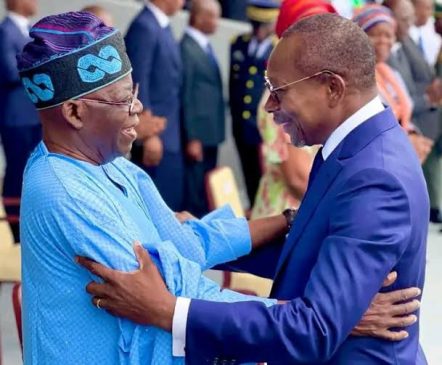
This reality came sharply into focus in July 2023 when a military clique ousted President Mohamed Bazoum of Niger Republic. At the time, President Bola Ahmed Tinubu, newly sworn in and serving as Chairman of ECOWAS, took the principled stand of rallying the region to restore constitutional order. It wasn’t an emotional decision. It wasn’t imperialism. It was simple geopolitical logic: if Niger falls to a junta, Nigeria will pay the price.
But back home, the conversation derailed.
A wave of misinformation, political propaganda, and deliberate distortion swept through the public space. The attempt to restore democracy in Niger was repackaged as “Tinubu’s personal war.” The shared border between both nations was romanticised as a mythical sibling bond. Political opportunists weaponised the crisis, fuelling sentiment that had nothing to do with national security. Some even vowed to punish Tinubu at the polls in 2027 over a decision that was, in fact, designed to protect Nigeria from future instability.
Yet here we are in 2025—facing the consequences of that collective failure.
Across the Sahel, military regimes have sprung up like wildfire: Mali, Burkina Faso, Guinea, Niger. Terror cells roam freely. Arms trafficking routes have multiplied. Kidnap syndicates and bandits now exploit wide-open corridors. The dangers that experts warned about are no longer hypothetical; they are our lived reality.
Then came December 2025.
A dawn coup attempt rattled Benin Republic, Nigeria’s closest southern neighbour—geographically, economically, and culturally. President Patrice Talon’s government came under siege, and within hours, an urgent distress call went out. Nigeria responded immediately. Discreetly. Professionally. Fighter jets were deployed—not to wage war, but to neutralise a destabilizing attempt against a democratic government.
The coup collapsed swiftly. Calm returned. Benin was saved.
And this time, the loud voices that politicised the Niger crisis went silent.
Why?
Because Tinubu is no longer the Chairman of ECOWAS.
Because there was no political mileage to gain.
Because, stripped of propaganda, Nigerians could finally see the intervention for what it was: a patriotic duty performed in good faith.
The hypocrisy was unmistakable.
The same people who preached “don’t attack our Nigerien siblings!” suddenly had no objection when Nigeria intervened in Benin Republic—another nation with which we share deep bloodlines and cultural ties. The difference wasn’t in principle. It was in politics.
What happened in Benin vindicated Tinubu’s stance in 2023.
His insistence on defending democracy was not reckless—it was visionary.
His warnings about regional instability were not alarmist—they were accurate.
His understanding of Nigeria’s role in West Africa was not overbearing—it was responsible.
As insecurity sweeps the Sahel, the question writes itself:
Where would Nigeria be today if ECOWAS had acted swiftly in Niger?
History offers a painful but necessary lens: military regimes in Africa do not end well. They breed corruption, economic collapse, terrorism, and mass exodus. Every nation that has embraced military rule in recent years is now grappling with these consequences.
Tinubu saw this early.
He acted early.
He was resisted early.
And now, he is vindicated.
Nigeria’s decisive intervention in Benin Republic shows what stable leadership can achieve. It reinforces our standing as the region’s backbone. It underscores a timeless truth: where democracy falters in West Africa, Nigeria must hold the line.
This is not just a story of two coups.
It is the story of a President whose judgement was mocked before it was understood.
A leader whose foresight may have spared Nigeria a deeper crisis.
And a nation that is slowly realising that security is not a political debate—it is survival.
As the dust settles in Benin Republic, one thing is clear:
Tinubu’s foreign policy doctrine—anchored on regional stability, democratic legitimacy, and swift intervention—has proven not just correct, but indispensable.
And for those who once shouted the loudest, silence has never been more revealing.