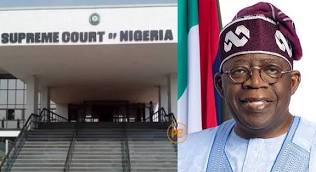
The Supreme Court on Monday affirmed the constitutional authority of the President to declare a state of emergency in any state and, where necessary, suspend elected officials to restore law and order.
In a split decision of six to one, a seven-member panel of the apex court dismissed a suit filed by 11 states challenging President Bola Tinubu’s declaration of emergency rule in Rivers State and the subsequent suspension of the governor, deputy governor, and members of the State House of Assembly.
Delivering the majority judgment, Justice Mohammed Idris held that Section 305 of the 1999 Constitution (as amended) empowers the President to take extraordinary measures to prevent a breakdown of law and order during a state of emergency. The court noted that although the Constitution does not expressly define such measures, it grants the President discretion to act in the interest of national stability. However, the court stressed that any suspension of elected officials must be temporary and limited in duration.
The court also upheld preliminary objections raised by the Attorney General of the Federation and the National Assembly, ruling that the plaintiffs failed to establish a valid dispute to invoke the Supreme Court’s original jurisdiction. Consequently, the suit was dismissed for lack of jurisdiction.
The plaintiffs—states governed by the Peoples Democratic Party (PDP)—had argued that the President lacked the constitutional power to suspend democratically elected state officials under emergency rule.
Justice Obande Ogbuinya dissented, holding that while the President could declare a state of emergency, such power did not extend to suspending elected officials.
President Tinubu had declared emergency rule in Rivers State on March 18 and appointed Vice Admiral Ibok-Ete Ibas (rtd.) as Sole Administrator for six months, a move later endorsed by the National Assembly.