By Uzo Amadi
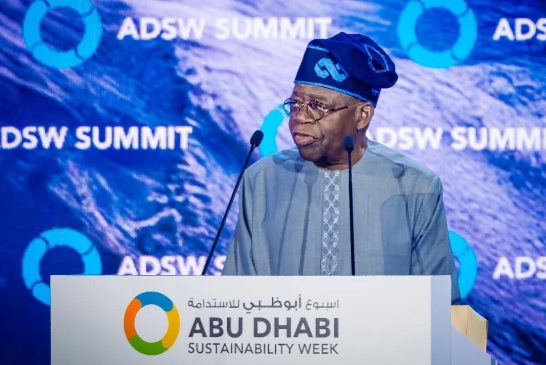
President Bola Ahmed Tinubu’s participation in the 2026 Abu Dhabi Sustainability Week (ADSW2026) and the signing of a Comprehensive Economic Partnership Agreement (CEPA) between Nigeria and the United Arab Emirates represent a significant milestone in Nigeria’s economic diplomacy. Beyond the symbolism, the agreement opens concrete investment and development pathways that regions across the country must urgently position to harness. For the South-East, this moment presents both an opportunity and a test of strategic coordination.
The CEPA is designed to deepen economic cooperation between Nigeria and the UAE by boosting bilateral trade and investment, enabling technology transfer, and expanding collaboration in key sectors such as energy, infrastructure, agriculture, mining, and renewable energy. Complementing this is President Tinubu’s announcement that Nigeria will host a joint Nigeria–UAE INVESTOPIA in Lagos in February 2026, a global investor-focused platform aimed at unlocking capital inflows. The President also reaffirmed Nigeria’s ambition to mobilise up to $30 billion annually in climate and green industrial finance to drive energy transition reforms and expand electricity access nationwide.
These priorities align closely with the economic realities and development needs of the South-East.
For decades, the region has been known for its entrepreneurial energy, industrial ingenuity, and trading networks, yet it has remained constrained by infrastructure deficits, especially in power, transport, and access to large-scale capital. The emerging Nigeria–UAE economic framework offers a chance to reverse this pattern—if the region acts in a coordinated and forward-looking manner.
This is where the South-East Development Commission (SEDC) becomes critical. Established to drive coordinated development across the region, the Commission can serve as the institutional vehicle through which the South-East translates federal-level agreements into bankable regional projects.
One of the most immediate entry points is renewable and decentralised energy. With energy transition now central to national policy, the South-East can leverage solar, hybrid mini-grids, waste-to-energy systems, and small hydro solutions to power industrial clusters in Aba, Nnewi, Onitsha, Enugu, Awka, Owerri, and Abakaliki. Access to climate and green industrial finance—highlighted at ADSW2026—makes these projects increasingly viable. Through the SEDC, the region can aggregate such initiatives and present them as scalable investment opportunities to UAE-backed financiers.
Industrial development is another natural fit. The UAE’s global experience in industrial parks, logistics hubs, and export-oriented manufacturing aligns with the South-East’s established clusters in leather, garments, auto parts, light engineering, and trade. By repositioning these clusters as green and modernised industrial hubs, the region can attract technology transfer, improve productivity, and expand export potential under the CEPA framework.
Agriculture and agro-processing also present strong prospects. With fertile land and a resilient farming population, the South-East can benefit from UAE investment in modern agro-processing zones, cold-chain logistics, and export-grade value chains for crops such as cassava, rice, oil palm, and vegetables. Rather than fragmented state-level pitches, a unified regional agricultural investment portfolio coordinated by the SEDC would significantly enhance attractiveness to international investors.
In the solid minerals sector, the CEPA’s focus on mining opens doors for responsible and environmentally compliant exploitation of limestone, lead-zinc, salt, and other industrial minerals found in the South-East. Properly structured, these projects can support industrial growth while aligning with sustainability standards demanded by global investors.
Infrastructure development cuts across all these opportunities. UAE firms are global leaders in smart cities, climate-resilient infrastructure, and transport logistics. The South-East’s pressing needs—industrial roads, urban regeneration, logistics corridors, and modern transport links—can be packaged into region-wide proposals that fit into Nigeria’s broader infrastructure and sustainability agenda.
The forthcoming Nigeria–UAE INVESTOPIA in Lagos provides a near-term platform to advance these ambitions. However, meaningful participation will depend on preparation. The SEDC must coordinate South-East state governments, the private sector, chambers of commerce, and the diaspora to curate a coherent South-East investment portfolio. By acting as a single interface between regional projects and federal investment promotion platforms, the Commission can ensure the region is visible, credible, and competitive.
The Nigeria–UAE partnership signals a decisive shift toward investment-led and climate-aligned development. For the South-East, this is not a moment for fragmented efforts or rhetorical support but for deliberate action. The opportunities are tangible, the timelines are clear, and global capital is actively searching for well-structured regional entry points.
The South-East Development Commission must, therefore, move swiftly from policy aspiration to execution. It must rally State governments, the private sector, traditional institutions, and the diaspora behind it. The Commission as the coordinating engine for project preparation and investor engagement should lead the way.
*Uzo Amadi writes from Abuja and can be reached at uzocamadi@yahoo.com