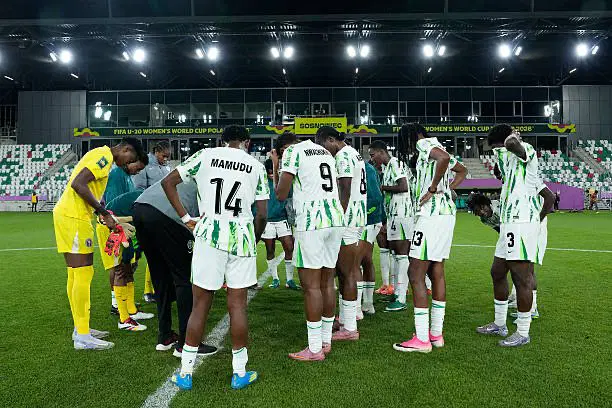

Nigeria’s Nigeria women’s national basketball team, popularly known as D’Tigress, produced a campaign of mixed fortunes at the FIBA Women’s Basketball World Cup 2026 Qualifying Tournament in Villeurbanne, France, winning two of their four games while gaining valuable experience ahead of the FIBA Women’s Basketball World Cup.
Although Nigeria had already secured qualification for the global tournament through their continental success, the qualifiers offered an important test against teams from different basketball traditions. Across four matches, D’Tigress displayed their trademark physicality and resilience but also revealed tactical areas that will require improvement before the world stage.
Strong start against Colombia
Nigeria opened their campaign with an emphatic 70–37 victory over the Colombia women’s national basketball team.
D’Tigress immediately asserted their defensive authority, restricting Colombia’s scoring opportunities while gradually building a comfortable lead. Nigeria’s physical presence inside the paint and aggressive rebounding ensured they controlled possession throughout the contest.
The decisive moment came after halftime when Nigeria produced a dominant third-quarter run that effectively ended the contest. Colombia struggled to cope with Nigeria’s intensity, finishing the game with just 37 points as D’Tigress cruised to a convincing opening win.
South Korea halt Nigeria’s momentum
Nigeria’s early momentum was checked in their second game with a 77–60 defeat to the South Korea women’s national basketball team.
South Korea’s speed and perimeter shooting exposed weaknesses in Nigeria’s defensive rotations. Quick ball movement stretched the Nigerian defence and created open looks from outside, allowing the Asian side to steadily widen the gap.
While D’Tigress attempted to mount a response in the second half, they struggled to match South Korea’s offensive efficiency and eventually fell short by 17 points.
The defeat highlighted the challenge Nigeria often face against teams that rely heavily on fast ball circulation and accurate long-range shooting.
D’Tigress respond with offensive explosion
Nigeria bounced back impressively in their third match, defeating the Philippines women’s national basketball team 101–84.
After a closely contested opening half, D’Tigress surged ahead with a powerful second-half performance. Their transition play proved devastating, as Nigeria repeatedly capitalised on turnovers and fast breaks.
The victory saw Nigeria surpass the 100-point mark, demonstrating their offensive potential when the team plays at a high tempo. It also reaffirmed the squad’s resilience, responding strongly after their earlier setback.
Hosts France prove too strong
Nigeria concluded their campaign with a 62–84 defeat to the France women’s national basketball team.
France controlled the tempo from the outset, using disciplined defence and efficient ball movement to limit Nigeria’s scoring opportunities. The hosts gradually extended their advantage, relying on their depth and tactical organisation to maintain control throughout the game.
Nigeria struggled to break down France’s defensive structure in half-court situations, and the hosts ultimately secured a comfortable 22-point victory.
Lessons from the tournament
Nigeria finished the qualifying event with two wins and two defeats, a record that reflected both their strengths and their vulnerabilities.
One of D’Tigress’ greatest assets remains their physicality. Against Colombia and the Philippines, Nigeria dominated through defensive pressure, rebounding strength and fast-break scoring. When they succeed in forcing turnovers and pushing the pace, they become one of the most dangerous transition teams in women’s international basketball.
However, the matches against South Korea and France exposed recurring weaknesses. Nigeria struggled to contain teams that rely on perimeter shooting and quick ball circulation. Defensive spacing and rotations occasionally broke down, allowing opponents to generate open three-point opportunities.
Another issue was offensive consistency. While Nigeria showed they can score heavily in open play, they sometimes found it difficult to create efficient scoring chances in structured half-court situations against well-organised defences.
What must improve before the World Cup
With their place already secured at the FIBA Women’s Basketball World Cup, the qualifiers served as an important rehearsal for Nigeria.
Improving perimeter defence will be crucial. At the highest level, many teams rely on three-point shooting to stretch defences, and Nigeria must tighten their rotations and close-outs to prevent opponents from exploiting space.
Equally important is the development of a more structured half-court offense. When transition opportunities disappear, Nigeria will need greater ball movement and tactical discipline to generate high-percentage scoring chances.
Depth will also play a major role. Against elite teams like France, deeper rotations can help maintain defensive intensity throughout four quarters.
A team with potential
Despite the mixed results, the tournament reinforced Nigeria’s status as Africa’s leading women’s basketball power. The team showed resilience, responded strongly to setbacks and demonstrated the attacking potential that has made them a dominant force on the continent.
If D’Tigress can refine their defensive organisation and improve offensive efficiency against structured opponents, they could emerge as a dangerous challenger when the world’s best teams meet at the next Women’s World Cup.
*Culled from Moor Sports (FB)