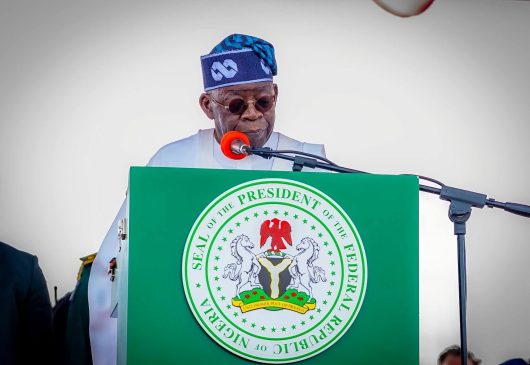
President Bola Ahmed Tinubu on Friday, June 12, 2026, delivered his Democracy Day address, highlighting Nigeria’s 27 years of uninterrupted civilian rule since the return to democracy in 1999.
He described the period as the longest stretch of civilian governance in the nation’s history, noting that Nigerians have consistently chosen leaders through the ballot and resolved disputes through institutions rather than violence.
The President urged INEC, security agencies, and political parties to ensure credible and peaceful governorship elections in Ekiti and Osun States in the coming days, warning that public doubt in the electoral process undermines democracy.
Tinubu commended the National Assembly, Judiciary, the Press, and Civil Society as essential guardrails of the republic, while appealing to young Nigerians to invest their talents and futures in the country rather than seeking opportunities abroad.
Addressing security concerns amid recent child abductions in Oyo and Borno States, the President declared a security emergency, announced the recruitment of over 50,000 new police officers and thousands of military personnel, and revealed a record N5.41 trillion allocation to defence and security in the 2026 budget.
He reported significant gains against terrorism, including the degradation of ISWAP’s command centre in Arege, Borno State, an 81% reduction in terror-related deaths since 2015, and the neutralisation of over 13,000 terrorists in the past year, while noting that more than 124,000 fighters and dependents have surrendered through Operation Safe Corridor since 2023.
Tinubu issued a stern warning to bandits, kidnappers, and their sponsors to surrender or face the full force of the state, emphasising national unity against crime which he said has no ethnicity.
The President paid tribute to the heroes of the June 12, 1993, struggle, remembering Chief M.K.O. Abiola, Alhaja Kudirat Abiola, and numerous other patriots including Chief Gani Fawehinmi, Chief Bola Ige, and many more who sacrificed for the nation’s democracy.
Reflecting on the economic challenges inherited in 2023, Tinubu defended the administration’s reforms as necessary for restoring stability, noting increased federation revenues, improved fiscal transparency, and growing investments across multiple sectors.
He highlighted progress in the power sector, including the signing of the Electricity Act empowering states, efforts to clear legacy debts through a N4 trillion bond, and the deployment of off-grid solutions to underserved areas.
The President pointed to infrastructure developments, the National Agricultural Development Fund’s plan to deploy 10,000 tractors, growth in non-oil exports by 21%, and certification of over 1,000 SMEs for export as signs of advancing economic freedom.
In recognition of contributions to democracy, Tinubu announced the renaming of the Institute of Petroleum Studies in Kaduna as the General Shehu Musa Yar’Adua University of Geological Sciences and Engineering Technology, and listed numerous Nigerians to receive national awards for their roles in the June 12 struggle.
He concluded by calling on Nigerians to embrace unity, reject despair, and work towards securing economic prosperity so that democracy is felt in the daily lives and pockets of citizens, reaffirming that the labours of past heroes shall not be in vain.