By Ngozi Emedolibe
Seasoned political journalist Tolani Abatti presents a historical compendium of the women who have shaped Lagos State over the past 60 years in a richly illustrated volume written in fluid, engaging prose.
Lagos occupies a strategic position in the socio-economic landscape not only of Nigeria but of Africa. With a population of nearly 20 million people, drawn from diverse ethnic groups and nationalities, and a Gross Domestic Product (GDP) that surpasses those of many African countries, it is understandable why its politics—and indeed its bureaucracy—matter so much.
Since its creation in 1967, Lagos has evolved from the Federal Capital Territory into one of Nigeria’s most influential states. Its remarkable growth and enduring symbolism have been shaped by exceptional personalities whom providence placed at the helm of its affairs over the decades.
These personalities include military and civilian leaders, men and women, indigenes and non-indigenes, all united by a shared commitment to leaving Lagos better than they met it. Although, in a largely patriarchal society, the contributions of men have traditionally received greater attention, countless women have also played significant roles in building the Lagos that is proudly known today as the Centre of Excellence.
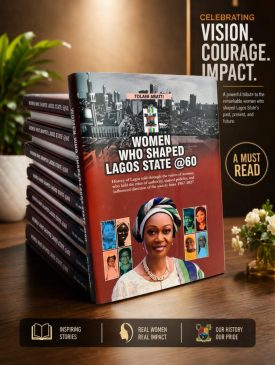
It is the stories and contributions of these remarkable women that make Women Who Shaped Lagos @60, written by renowned journalist Tolani Abatti, a unique and valuable historical work. Arguably the first publication of its kind on Lagos State, the 220-page book is divided into seven meticulously researched chapters.
Chapter One focuses on the women who have served as First Ladies of Lagos State. Although the office of the First Lady has no constitutional recognition, successive occupants have profoundly influenced governance through advocacy, philanthropy and social intervention programmes.
Chapter Two chronicles women whose political careers in Lagos propelled them to national prominence, while Chapter Three examines women who served in the Executive Arm of government and contributed to policy formulation through the State Executive Council.
Chapter Four profiles women parliamentarians, while Chapter Five shines the spotlight on female judicial officers under the title Women on the Bench. Chapters Six and Seven focus respectively on Women in Academic Leadership and The Local Powerhouses, celebrating women who have distinguished themselves in academia and grassroots politics.
Beginning with the late Mrs Olufunmilayo Johnson, wife of Brigadier Mobolaji Johnson, the first Military Administrator of Lagos State, the book chronicles the lives and accomplishments of every First Lady in the state’s history. Mrs Johnson is credited with establishing the Committee of Wives of Lagos State Officials (COWLSO), an organisation that has grown into one of the state’s foremost platforms for social intervention. COWLSO was later revitalised and expanded during the tenure of Senator Oluremi Tinubu as First Lady in the early years of the Fourth Republic.
The book proceeds chronologically through the subsequent First Ladies: Adefunmilayo Lawal (wife of Commodore Adekunle Lawal), Christine Nwanyife Kanu (wife of Rear Admiral Ndubuisi Kanu), Amina Ukiwe (wife of Navy Commodore Ebitu Ukiwe), Sikirat Jakande (wife of Alhaji Lateef Jakande, the first civilian Governor of Lagos State), Foluke Asabi Mudashiru (wife of Air Commodore Gbolahan Mudashiru), Josephine Akhigbe (wife of Vice Admiral Mike Akhigbe), Fatimat Raji-Rasaki (wife of Brigadier Raji Rasaki), Christine Otedola (wife of Sir Michael Otedola), Princess Omolola Oyinlola (wife of Brigadier Olagunsoye Oyinlola), Munirat Buba Marwa (wife of Brigadier Mohammed Buba Marwa), Senator Oluremi Tinubu (wife of Bola Ahmed Tinubu), Dame Emmanuella Abimbola Fashola (wife of Babatunde Raji Fashola), Bolanle Patience Ambode (wife of Akinwunmi Ambode) and Dr Claudiana Ibijoke Sanwo-Olu, wife of the incumbent Governor, Babajide Olusola Sanwo-Olu.
While documenting their lives, the author carefully examines how each First Lady impacted governance and improved the quality of life in Lagos through numerous initiatives, charitable projects and advocacy programmes.
The same level of detail characterises the profiles of women who distinguished themselves in legislative politics at the local, state and federal levels, the judiciary, academia and local government administration. The author also recognises grassroots politicians and mobilisers whose dedication has sustained the Lagos political structure across successive generations.
One of the book’s greatest strengths is its documentation of female pioneers in governance. It identifies Mrs Kofoworola Abeni Pratt as the first woman appointed Commissioner in 1973; Justice Modupe Oladunni Omo-Eboh as the first woman appointed a judge; Abiola Olubunmi Babatope as the first woman from Lagos State elected to the House of Representatives, following her earlier election as a councillor in 1977; Senator Louisa Akerele-Bucknor as the state’s first female senator; Professor Jadesola Akande as the first female Vice-Chancellor; Princess Adejoke Orelope-Adefulire as the first woman elected to the Lagos State House of Assembly; Professor Adenike Grange as the first female Federal Minister from Lagos State, following her appointment as Minister of Health in 2007; Stella Olubukola Odesanya as the state’s first female Permanent Secretary, having attained the position in 1975; and Lateefat Okunnu as the first female Deputy Governor of Lagos State.
As a historical reference, this book stands out as a credible and authoritative account written by a journalist who has reported Lagos politics for several decades. That extensive experience also inspired his acclaimed 2021 publication, Two Decades of Lagos Assembly: Face to Face with the Movers and Shakers; Dr Femi Oke-Osanyintolu: A Quintessential Disaster Manager; and The Authentic Heroes and Heroines of Ojokoro LCDA in the Last 20 Years.
The same passion and commitment are evident in this latest work, which deservedly celebrates women whose invaluable service has contributed immensely to the development of Lagos State.
Beyond its rich historical content and painstaking documentation, the book’s greatest achievement lies in giving long-overdue recognition to women whose contributions have often been overlooked. It serves as an inspiration to younger generations by demonstrating that leadership, excellence and public service are attainable aspirations for women. In many ways, it challenges the traditional stereotypes that seek to confine women solely to domestic roles.
Another remarkable feature of the book is the simplicity and elegance of its language. The author’s style is clear, engaging and free from unnecessary complexity, making the book accessible to readers of all ages, including students in junior secondary schools who wish to learn about the remarkable contributions of women to the governance of Lagos State. At a time when the importance of history is once again being emphasised in Nigeria’s educational curriculum, this book deserves a prominent place in secondary and tertiary school libraries across the country.
The cover design is attractive and effectively conveys the theme of the publication. Nevertheless, future editions could be enriched by expanding the scope to include women whose contributions came through civil society, pro-democracy activism and human rights advocacy. Distinguished personalities such as Funmi Falana, Joe Okei-Odumakin and Betty Abah, among others, have made significant contributions to shaping public policy and democratic governance in Lagos. Their inclusion would further strengthen what is already a landmark publication.
Overall, Women Who Shaped Lagos @60 is a significant contribution to the historiography of Lagos State. It is a carefully researched, well-written and highly readable work that not only preserves the legacy of outstanding women but also inspires future generations to aspire to leadership and public service.