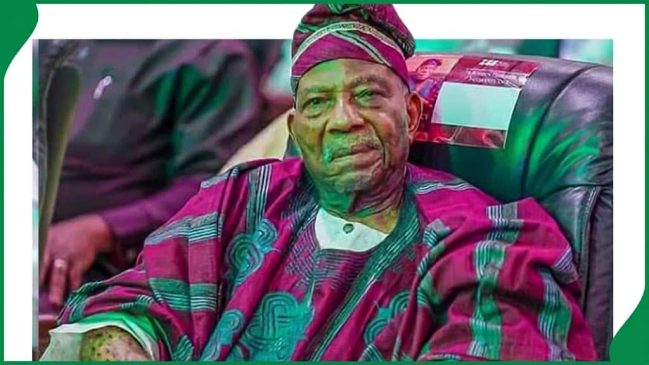
Pa Reuben Famuyide Fasoranti, elder statesman, educationist, pro-democracy activist and national leader of the pan-Yoruba socio-political organisation, Afenifere, has died at the age of 100. His death was announced on Tuesday by Ondo State Governor, Lucky Aiyedatiwa, in a statement personally issued by him.
Fasoranti, who celebrated his centenary on May 11, 2026, was widely respected for his contributions to education, democratic governance and the political development of Ondo State, Yorubaland and Nigeria.
Announcing the death, Aiyedatiwa described the late centenarian as a symbol of wisdom, integrity and selfless service whose influence extended across generations. “Pa Fasoranti was a patriarch, a beacon of wisdom, integrity and selfless service whose century-long life was marked by uncommon commitment to the development of our dear State, Yorubaland and Nigeria at large,” the governor said.
He added that the elder statesman’s counsel, fatherly guidance and principled positions on justice and good governance would be sorely missed. On behalf of the state government and its people, Aiyedatiwa extended condolences to the Fasoranti family, the people of Akure Kingdom and the entire state.
Born on May 11, 1926, Fasoranti devoted much of his early life to education before emerging as a prominent figure in Nigerian politics. He studied at the University College, Ibadan, now the University of Ibadan, where he obtained a degree in English and Geography. He subsequently earned a postgraduate diploma in Education from the University of Hull in the United Kingdom and a master’s degree in Education Administration and School Management from Macquarie University in Australia. His academic journey helped shape a career that combined teaching, school administration and public service.
As an educationist, Fasoranti taught at Ondo Boys’ High School and served as a school administrator in the Ondo-Akure axis and beyond. His commitment to learning continued after his formal teaching career, as he established educational institutions including Omolere Nursery and Primary School, Akure High School and St. Frances Academy in Akure. These initiatives reflected his belief that education was essential to individual advancement and community development. His contributions to the sector earned him recognition as one of Ondo State’s notable education advocates.
Fasoranti’s political journey was deeply influenced by the progressive philosophy of the late Chief Obafemi Awolowo, whom he regarded as a political mentor. He was associated with the Action Group during Nigeria’s First Republic and later became a member of the Unity Party of Nigeria.
Between 1979 and 1983, he served as Commissioner for Finance in the administration of the late Governor Michael Adekunle Ajasin in the old Ondo State. His supporters and political associates often cited his financial prudence, discipline and commitment to public service as defining features of his tenure.
Beyond elective and appointed political offices, Fasoranti became one of the most influential voices in Afenifere, championing Yoruba interests and advocating restructuring, federalism, equity and accountable governance. He emerged as the organisation’s leader following the death of Pa Abraham Adesanya, becoming a prominent voice in national debates about Nigeria’s political future. During the years of military rule, he was associated with the struggle for the restoration of democracy and reportedly survived an assassination attempt linked to the regime of the late General Sani Abacha. His political legacy was built on decades of advocacy for democratic governance and the protection of citizens’ rights.
His long life also included profound personal tragedy. In July 2019, his daughter, Funke Olakunrin, was killed in an attack along the Ondo-Ore Expressway, a killing that triggered widespread condemnation and renewed concerns about insecurity on Nigerian highways.
Despite the painful loss, Fasoranti remained an influential elder statesman whose views continued to attract attention across the country’s political landscape. His death marks the end of a remarkable century that spanned Nigeria’s colonial era, independence, military rule and democratic transitions. He leaves behind a legacy rooted in education, public service, Yoruba political thought and the struggle for democracy.