Book Review
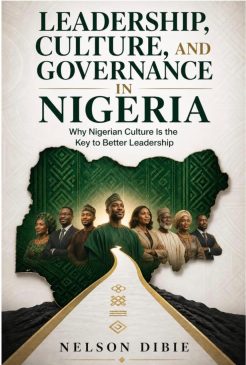
Leadership, Culture, and Governance in Nigeria: Understanding the Country Through Its Culture
Nigeria’s governance challenges cannot be understood solely through its political institutions, government policies or leadership structures. They must also be examined through the cultural values, social relationships and traditional expectations that influence how authority is exercised and public responsibilities are perceived.
This is the central argument of Leadership, Culture, and Governance in Nigeria: Understanding the Country Through Its Culture, a thought-provoking publication by Nigerian-born scholar and leadership expert, Dr. Nelson Dibie.
In the book, Dibie moves beyond conventional explanations of corruption, institutional weakness and poor leadership to examine how Nigeria’s cultural environment shapes governance. He explores how family obligations, communal loyalty, social networks and traditional expectations influence leadership conduct and citizens’ relationships with public institutions.
While acknowledging Nigeria’s cultural and ethnic diversity as a potential resource for national development, he also highlights the challenges that emerge when personal relationships and traditional loyalties take precedence over institutional rules, transparency and public interest.
One of the book’s notable contributions is its treatment of corruption. Rather than viewing it exclusively as an individual moral failure, Dibie examines the cultural and institutional conditions that allow unethical practices to persist. He argues that addressing corruption requires more than legislation and punishment; it demands ethical leadership, civic education, responsible citizenship and institutions that enforce accountability.
A Scholar with Practical Leadership Experience
Born in Kwale, Delta State, Dr. Dibie began his education at Army Children School and Bishop Phillips Academy, Ibadan, before proceeding to Federal Polytechnic, Oko, where he obtained his OND and HND qualifications.
Following his National Youth Service, he relocated to the United States, where he earned degrees in Mass Communication and Public Administration before obtaining a doctorate in Management and Leadership.
His professional career spans human resources management, organisational development and institutional leadership. He has held senior positions at Delaware North and Chicken Ranch Casino and served as Chief People and Culture Officer at Fresno Economic Opportunities Commission (Fresno EOC), one of the largest community action agencies in the United States.
Beyond his professional responsibilities, Dibie is an Adjunct Professor at Fresno Pacific University, teaching postgraduate courses in leadership, organisational ethics, conflict management, negotiation and organisational behaviour.
His combination of Nigerian cultural experience, international academic exposure and practical leadership experience provides a valuable foundation for examining the relationship between culture and institutional performance.
Leadership as Service and Accountability
A recurring theme in Dibie’s philosophy is that leadership goes beyond occupying positions of authority. It involves service, integrity, accountability, empowerment and the responsibility to create environments where people and institutions can thrive.
His contributions have earned him professional recognition, including Leadership of the Year in 2024. He also played a role in designing and launching the Fresno EOC Leadership Academy.
An ordained associate minister and active community mentor, Dibie brings both professional and personal perspectives to his understanding of leadership.
A Timely Contribution to Nigeria’s Development Debate
Ultimately, Leadership, Culture, and Governance in Nigeria challenges Nigerians to look beyond political officeholders and government policies and examine the cultural values and everyday behaviours that influence governance.
Its most compelling message is that Nigeria’s cultural diversity need not be an obstacle to national development. Properly harnessed through ethical leadership, civic responsibility and strong institutions, it can become a powerful resource for national progress.
For policymakers, students, public administrators and citizens interested in Nigeria’s future, Dibie’s work offers a valuable perspective on why sustainable institutional transformation must begin not only with changing systems but also with transforming the values and behaviours of those who operate them.