
The Executive Director/Chief Executive Officer of the National Film and Video Censors Board (NFVCB), Dr. Shaibu Husseini, has described the recent World Health Organization (WHO) President Award conferred on the Board as a global recognition of its efforts towards promoting safe and healthy screen content in the Nigerian film industry.
Dr. Husseini made this known during an interview on Villa Square, a programme on Mainland FM 98.3 under the Creative Nigeria segment hosted by Mr. Frank Meke and Mrs. Bumi Bade-Adeniji.
Speaking extensively on the significance of the award, the NFVCB boss explained that the recognition followed the Board’s deliberate efforts to enforce existing laws aimed at discouraging the promotion and glamorization of tobacco use in Nigerian films and other screen contents.
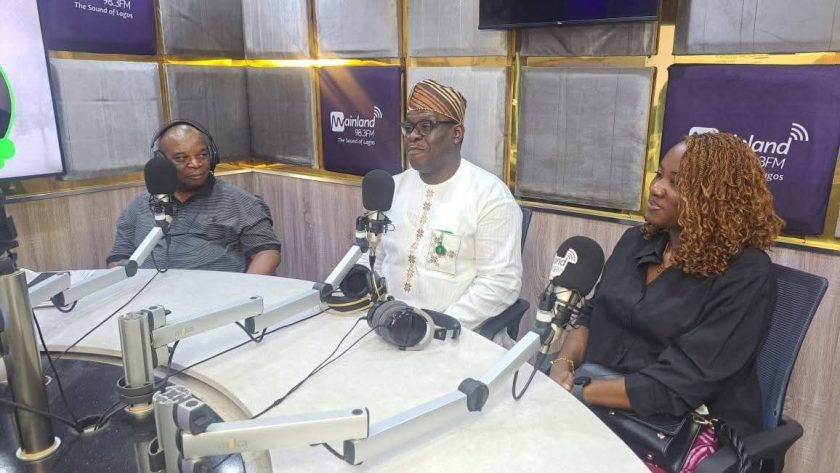
According to him, upon assumption of office, he discovered that Nigeria already had laws regulating tobacco promotion in films, but enforcement of the laws had remained weak over the years.
“As a regulator, we felt it was important to ensure that the law was not only acknowledged but fully implemented in line with global best practices aimed at protecting public health and promoting healthy screen content,” he stated.
Dr. Husseini disclosed that the Board’s renewed enforcement drive initially generated misconceptions within some quarters of the entertainment industry, with many stakeholders interpreting the policy as an outright ban on smoking scenes in films.
He, however, noted that the Board immediately embarked on stakeholder engagements and consultations to properly educate filmmakers and content creators on the true position of the law and the objectives of the policy.
“We had to engage stakeholders to make them understand that the issue was not about banning creativity, but about discouraging the unnecessary glamorization and promotion of smoking on screen, especially in contents accessible to younger audiences,” he explained.
The NFVCB Executive Director described dialogue and engagement as the most effective way of driving policy implementation in the creative industry, adding that the Board’s approach has continued to receive growing acceptance and support from stakeholders.
Dr. Husseini expressed appreciation to the World Health Organization for the honour, noting that the official presentation of the award is scheduled for May 30.
He further revealed that Nigeria has become the first country in Africa and the second in the world after India to effectively enforce tobacco control regulations within the film industry.
Speaking on the broader impact of Nollywood on the Nigerian economy, Dr. Husseini described the film industry as one of the most vibrant and rapidly growing sectors in the country today.
According to him, film production has continued to generate massive employment opportunities for Nigerians, as every movie production engages several professionals directly and indirectly across different aspects of the value chain.
“If there is any business that is doing very well in Nigeria today, the film industry should be counted among them because of the number of people it engages and the economic opportunities it creates,” he stated.
He explained that producers are increasingly generating substantial income from cinema releases, online streaming platforms, and other distribution channels, thereby contributing significantly to the nation’s economy.
The NFVCB boss also commended the Honourable Minister of Art, Culture, Tourism and the Creative Economy, Barr. Hannatu Musa Musawa, for her unwavering support towards the advancement of the film industry and the operations of the Board.
He particularly acknowledged the Minister’s role in facilitating interventions and approvals that have positively impacted cinema operators and other stakeholders within the industry.
Dr. Husseini further stressed the need for the Nigerian film industry to align more strategically with tourism development.
Using South Africa as an example, he noted that locations used for the production of popular films have become major tourist attractions generating substantial revenue for the country.
He cited the famous Shaka Zulu production location as a successful example of film-tourism integration and encouraged Nigerian filmmakers to preserve and develop their production locations into viable tourism assets.
According to him, productions such as Anikulapo and several others possess strong tourism potential if properly maintained and upgraded.
Speaking on the financial strength of Nollywood, Dr Husseini described the industry as a multi-billion-naira sector with enormous growth potential.
He observed that notable filmmakers such as Funke Akindele and Toyin Abraham are already generating billions of naira from individual film projects, a development he said demonstrates the growing commercial value of the industry.
He therefore advised stakeholders to explore ways of monetizing every segment of the film value chain in order to create more opportunities for practitioners and attract greater investment into the sector.
On concerns surrounding ritual-related contents in movies, Dr. Husseini clarified that the Board’s focus is no longer on outright censorship but on proper classification and responsible regulation.
He explained that filmmakers remain free to express their creativity, but every production must pass through the Board’s classification process to ensure that contents are suitable for the appropriate audience categories and aligned with healthy screen standards.
The NFVCB boss also emphasized the need to preserve Nigeria’s cultural heritage through film by producing documentaries and biographical films that celebrate legendary figures in music and culture.
He specifically mentioned icons such as King Sunny Ade and Chief Osita Osadebe as personalities whose legacies deserve to be immortalized through film productions for future generations.
On collaboration within the entertainment industry, Dr. Husseini disclosed that the Board has continued to engage relevant stakeholders and institutions, including the Nigeria Film Corporation (NFC), to strengthen cooperation across the sector.
He noted that discussions with the Executive Director of the NFC, Dr. Ali Nuhu, and other stakeholders have focused on building stronger institutional partnerships capable of repositioning the industry for sustainable growth.
Dr. Husseini maintained that the NFVCB has undergone significant transformation under his leadership and assured Nigerians that his administration remains committed to leaving behind a stronger and more technologically driven institution.
According to him, the Board is working towards establishing a well-structured database system and deploying modern technological frameworks that will not only enhance regulation but also create more employment opportunities and project a positive image for Nigeria globally.
He concluded by appreciating Mainland FM 98.3 for consistently providing him with a platform to discuss issues concerning the creative industry, describing his appearance on the station as a homecoming.